
Recent Victories
Drug Crimes We Handle
Our comprehensive defense practice covers all drug-related charges across Southwest Michigan, from simple possession to complex federal trafficking cases.
Michigan Drug Laws and Penalties
Michigan organizes controlled substances into schedules that determine charge severity and potential sentences. Understanding these classifications helps explain why similar-seeming charges can carry vastly different penalties.
- Schedule I Substances have high abuse potential with no accepted medical use in the United States. Michigan includes heroin, ecstasy (MDMA), LSD, peyote, and marijuana (outside medical and recreational exceptions) in this category. Even small amounts can result in felony charges and years in prison.
- Schedule II Substances have high abuse potential but accepted medical uses with severe restrictions. This category includes cocaine, methamphetamine, oxycodone, fentanyl, morphine, and pharmaceutical amphetamines like Adderall. These substances carry the harshest penalties due to their combination of abuse potential and legitimate medical applications.
- Schedule III Substances have moderate abuse potential with accepted medical uses. Examples include anabolic steroids, certain barbiturates, and some prescription painkillers. Penalties are less severe than Schedules I and II but still carry significant consequences.
- Schedule IV Substances have lower abuse potential with accepted medical uses. This category includes many prescription medications like Xanax, Valium, Ambien, and Tramadol. While penalties are reduced, illegal possession or distribution still results in criminal charges.
- Schedule V Substances have the lowest abuse potential with accepted medical uses, typically including medications with limited narcotic content like certain cough syrups and anti-diarrheal medications.
Simple Possession Penalties:
- Marijuana: Civil infraction for adults (up to 2.5 oz), misdemeanor for larger amounts;
- Schedule I-II substances: Felony charges, up to 4 years in prison, $25,000 fines;
- Schedule III-IV substances: Misdemeanor or felony, depending on the amount;
- Prescription drugs without a prescription: Misdemeanor or felony based on quantity.
Possession with Intent Penalties:
- Based on drug type and amount involved
- Felony charges ranging from 4 years to life imprisonment
- Fines from $25,000 to $1,000,000
- Asset forfeiture possibilities
- Enhanced penalties near schools or parks
Distribution and Trafficking Penalties:
- Long minimum sentences for large quantities
- Life imprisonment possible for major trafficking
- Massive fines up to $1,000,000 or more
- Asset forfeiture of property connected to crimes
- Federal charges possible for interstate activity
Manufacturing Penalties:
- Among the most serious drug charges
- Up to life imprisonment for large operations
- Massive fines and asset forfeiture
- Additional charges for environmental damage
- Enhanced penalties for operations near schools
Drug convictions create lasting consequences that often prove more damaging than the immediate criminal penalties:
Employment Consequences:
- Background check failures for most employment
- Automatic disqualification from many jobs
- Loss of professional licenses and certifications
- Ineligibility for government employment
- Difficulty obtaining occupational licenses
Housing and Financial Consequences:
- Rental application rejections
- Eviction from federally subsidized housing
- Student loan disqualification
- Professional school admission problems
- Credit and loan application difficulties
Personal and Family Consequences:
- Child custody and visitation restrictions
- Immigration consequences for non-citizens
- Deportation risks for legal residents
- Travel restrictions to certain countries
- Social stigma and relationship impacts
Protecting Your Constitutional Rights
Drug cases frequently involve constitutional violations that can lead to case dismissal or evidence suppression. Law enforcement agencies use increasingly sophisticated techniques to investigate drug crimes, but they must still respect constitutional protections throughout the process.
Fourth Amendment Protection Against Illegal Searches
The Fourth Amendment protects against unreasonable searches and seizures, requiring police to follow strict procedures when stopping vehicles, searching property, or arresting suspects. When officers violate these rules, we can suppress illegally obtained evidence, often resulting in the case being dismissed.
Common search and seizure violations:
- Traffic stops without reasonable suspicion
- Vehicle searches without probable cause or consent
- Home searches without valid warrants
- Searches exceeding warrant scope
- Searches based on invalid or stale warrants
- Searches conducted after illegal arrests
Fifth Amendment Protection Against Self-Incrimination
The Fifth Amendment protects against compelled self-incrimination, including the right to remain silent during police questioning. Miranda warnings must be given before custodial interrogation, and suspects can invoke these rights at any time.
Miranda rights violations:
- Questioning suspects without Miranda warnings
- Continuing interrogation after the suspect invokes rights
- Using subtle interrogation techniques to circumvent Miranda
- Failing to clarify when suspects invoke rights
- Using statements obtained through Miranda violations
Chain of Custody and Evidence Integrity
Drug evidence must be properly collected, stored, and tested to be admissible in court. Broken chains of custody, contaminated samples, or improper testing procedures can result in evidence being excluded from trial.
Common chain of custody problems:
- Gaps in documentation from collection to testing
- Improper storage leading to contamination
- Mislabeling or mixing up evidence
- Laboratory errors in testing procedures
- Lack of proper credentials for testing personnel
- Failure to follow standard testing protocols

Meet Our Drug Crime Defense Team
The efforts of our three attorneys are backed up by a full support team. When you choose Markou | Montague | Levine Defense, you’ll have access to a group of talented legal professionals who all know your case and are working toward the same outcome.

Anastase Markou
30+ Years of Criminal Defense
Sarissa K. Montague
18+ Years of Criminal Defense
Randall S. Levine
45+ Years of Criminal Defense




Our journey began in 1987, and since then, we have evolved to protect our clients' future, securing the best possible outcomes. We prioritize: custom strategies for every case, clear communication, and personalized attention.
Areas We Serve
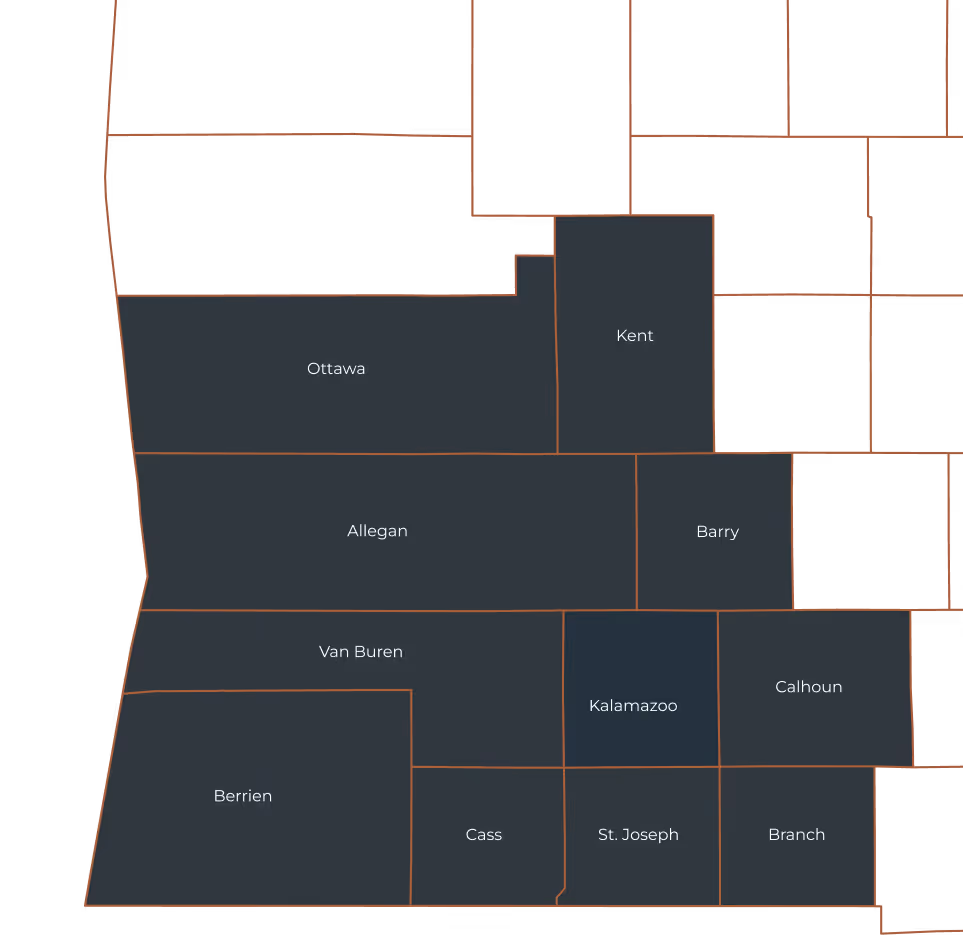
Based in Kalamazoo, our criminal defense team serves clients throughout Southwest Michigan:
Primary Counties:
- Kalamazoo County
- Van Buren County
- Allegan County
- Barry County
- Calhoun County
- St. Joseph County
- Branch County
- Cass County
- Berrien County
- and surrounding communities
Michigan Statewide Services:
- Driver's License Restoration (throughout Michigan)
- Professional Licensing Defense (throughout Michigan)

Your Future Is Worth Fighting For
When facing drug charges, every moment matters. Don't wait to get the experienced legal representation you need. Our team is ready to listen to your story, explain your options, and start building your defense immediately.
Don't let drug charges destroy your future. Call now for the aggressive defense representation you deserve.
Frequently Asked Questions About Drug Charges
Exercise your right to remain silent and request an attorney immediately. Don't discuss your case with police, cellmates, or family members over recorded jail phones. Contact a trusted family member to help arrange bail, and remember that anything you say can be used against you in court. Avoid posting about your arrest on social media or discussing details with anyone except your attorney.
Yes, drug charges can be dismissed for various reasons, including illegal searches and seizures, insufficient evidence, laboratory errors, constitutional violations during arrest or investigation, prosecutorial misconduct, or lack of probable cause. Each case presents different opportunities for dismissal based on the specific facts, evidence, and police procedures involved. Early attorney involvement increases the chances of identifying dismissal opportunities.
State charges are prosecuted in Michigan courts under Michigan law, with Michigan penalties, while federal charges are prosecuted in federal courts and often carry mandatory minimum sentences that eliminate judicial discretion. Federal cases typically involve large quantities, interstate activity, use of federal facilities, or complex distribution networks. Federal procedures, bail requirements, and sentencing guidelines differ significantly from state cases.
Michigan law enhances penalties for drug offenses committed within 1,000 feet of schools, parks, playgrounds, or other designated drug-free zones. These enhanced charges can substantially increase potential jail time and fines, sometimes doubling the maximum penalties. However, prosecutors must prove you knew or should have known about the zone's existence, creating potential defense opportunities.
Michigan's expanded expungement laws allow more people to clear their records of drug convictions. Eligibility depends on the specific charges, case outcome, time elapsed since conviction completion, and your overall criminal history. Recent changes allow expungement of some felony drug convictions after specific waiting periods. We analyze each case individually to determine available record relief options.
Many drug convictions result in automatic driver's license suspension under Michigan's "any drug" law, even for offenses completely unrelated to driving. Suspension lengths depend on the specific charges and your criminal history. However, restricted licenses may be available for work, school, and medical purposes. Attorney Sarissa Montague specializes in driver's license restoration and can help navigate this complex process.
Professional licensing consequences depend on your specific license, the nature of charges, and your licensing board's policies. Healthcare professionals, teachers, lawyers, and others may face disciplinary action, including license suspension, probation, or revocation. We coordinate criminal defense with professional licensing defense to protect both your liberty and your livelihood. Early intervention often produces better outcomes. Attorney Randall Levine specializes in professional license defense work.
Case timelines vary significantly based on complexity, court schedules, and whether cases resolve through plea agreements or proceed to trial. Simple possession cases might resolve in 3-6 months, while serious trafficking or federal charges can take 12 to 24 months or longer. Cases involving complex legal motions, expert witnesses, or multiple defendants generally require more time than straightforward prosecutions.
Plea decisions require careful analysis of the evidence against you, potential trial outcomes, plea terms, and long-term consequences of conviction. Never accept a plea without understanding all consequences, including immigration effects, professional licensing impacts, and future enhancement possibilities. We thoroughly review all plea offers and negotiate better terms when possible before advising whether acceptance serves your interests.