
Recent Victories
Violent Crime Cases We Oversee
Violent crime charges cover a broad range of actions and conduct, and the appropriate defense strategy depends entirely on the facts of the case. Here are some of the offenses we help protect our clients against.
Penalties for Violent Crimes in Michigan
Michigan's violent crime penalties are some of the toughest in the state’s criminal code, with many offenses carrying mandatory minimums that eliminate the possibility of judicial discretion. Here’s what you might be looking at in your case.
Assault Offenses
- Simple assault: Misdemeanor; up to 93 days in jail
- Assault and battery: Misdemeanor; up to 93 days in jail
- Assault with intent to do great bodily harm: Felony; up to 10 years in prison
- Felonious assault: Felony; up to four years in prison
- Assault with intent to murder: Felony; up to life in prison
Robbery and Carjacking
- Unarmed robbery: Felony; up to 15 years in prison
- Armed robbery: Felony; up to life in prison
- Carjacking: Felony; up to life in prison
Homicide Offenses
- Involuntary manslaughter: Felony; up to 15 years in prison
- Voluntary manslaughter: Felony; up to 15 years in prison
- Second-degree murder: Felony; up to life in prison
- First-degree murder: Mandatory life in prison without the possibility of parole
Enhancement Factors That Can Increase Penalties
- Using a firearm in the commission of the offense (adds a mandatory two-year consecutive term)
- Having a prior felony conviction
- Targeting a vulnerable adult
- Engaging in gang-related activity
- Committing the offense in a protected zone (near schools or other designated areas)
Collateral Consequences Beyond Criminal Penalties
The repercussions of a conviction for a violent felony can reach into every corner of a person's life, including the following areas.
The repercussions of a conviction for a violent felony can reach into every corner of a person's life, including the following areas.
Convictions for violent crimes can impose significant barriers to employment in many industries. Background checks tend to flag these convictions prominently, and many employers have categorical policies against hiring people with violent criminal records.
Under both Michigan and federal law, a felony conviction results in the loss of one’s right to possess firearms. For those who hunt, work in security, or otherwise depend on the ability to own firearms, this can be a serious and long-lasting consequence.
Landlords routinely screen for violent crime convictions, and federal housing programs have specific restrictions regarding them. People with violent felonies on their record can therefore face a frustratingly narrow rental market.
A violent crime conviction, particularly one involving domestic violence, will directly affect child-custody and parenting-time determinations. Courts treat these convictions as relevant to fitness as a parent, regardless of when the offense occurred or the circumstances around it.
Possible Defense Strategies in Violent Crime Cases
When you entrust your case to a capable Kalamazoo violent crimes lawyer from Markou | Montague | Levine Defense, they may employ any of the following strategies to protect your freedom and reputation.
Michigan law provides a robust right to self-defense, including the “castle doctrine,” which affords the right to use force (including deadly force in some circumstances) to protect yourself in your home without a duty to retreat. “Stand your ground” principles enlarge that protection in certain public settings.
If you used force to protect yourself or someone else from harm, we can construct a defense around the context of the confrontation: the threat you faced, your response to it, and why it was justified under the circumstances.
Eyewitness misidentification is one of the most common causes of wrongful convictions in violent crime cases. Lineup procedures, lighting conditions, cross-racial identification, and the stress of the moment can all affect a witness’s reliability.
Our lawyers take a close look at how identifications were made, whether proper procedures were followed, and whether expert testimony on eyewitness reliability is appropriate.
Violent incidents are often chaotic, brief, and witnessed by people with their own perspectives and interests. That’s why we launch our own independent investigation, interviewing witnesses the police may not have talked to, obtaining surveillance footage before it's deleted, and reconstructing the timeline of events from every available source.
Physical evidence like DNA, blood spatters, fingerprints, ballistics, and fire-cause analysis is far from infallible. Our team works with independent forensic experts to assess the prosecution’s conclusions, point out methodological weaknesses, and present competing analyses where the evidence supports it.
Many violent crime charges require proof of specific intent, whether to kill, inflict great bodily harm, or permanently deprive. When the facts don't line up with the level of intent prosecutors are alleging, we fight the charge directly and push for a lesser offense that more accurately reflects what occurred.
If a trial isn’t the best path forward, our lawyers negotiate effectively for reduced charges, sentencing agreements that avoid mandatory minimums, and dispositions that offer our clients the best possible outcome under the circumstances.

Meet Our Violent Crimes Defense Team
The efforts of our three attorneys are backed up by a full support team. When you choose Markou | Montague | Levine Defense, you’ll have access to a group of talented legal professionals who all know your case and are working toward the same outcome.

Anastase Markou
30+ Years of Criminal Defense
Sarissa K. Montague
18+ Years of Criminal Defense
Randall S. Levine
45+ Years of Criminal Defense




Our journey began in 1987, and since then, we have evolved to protect our clients' future, securing the best possible outcomes. We prioritize: custom strategies for every case, clear communication, and personalized attention.
Areas We Serve
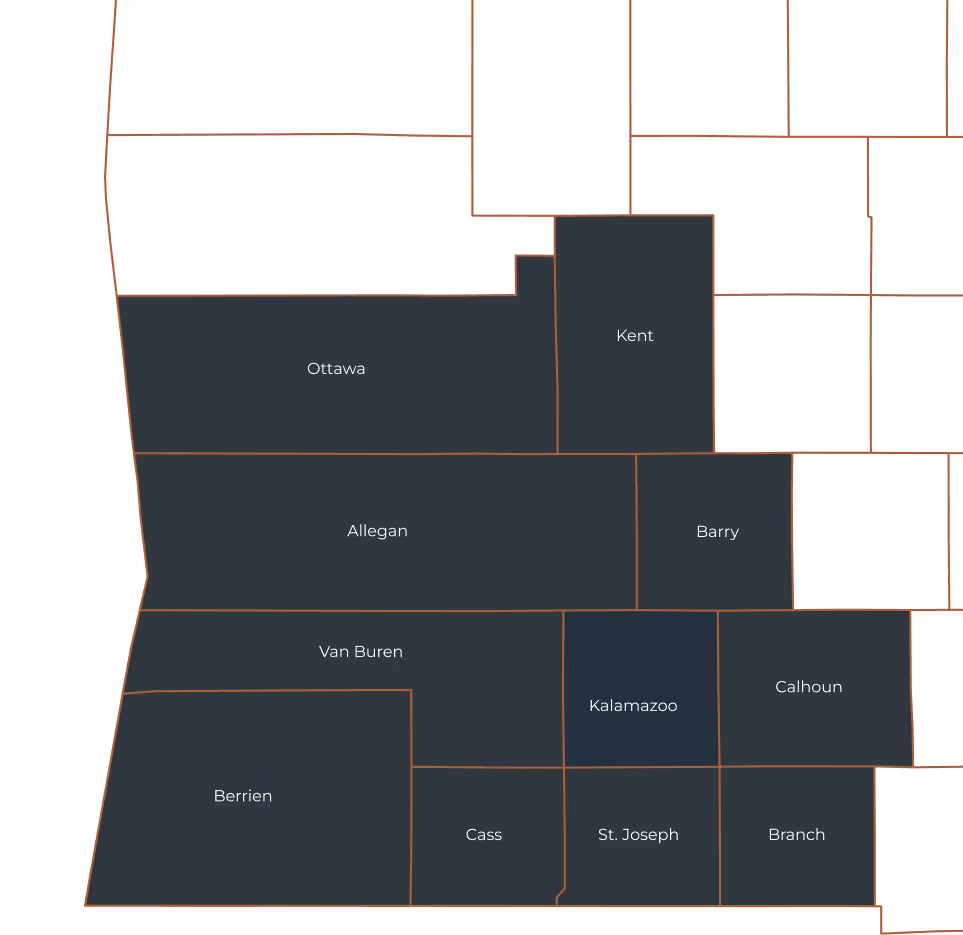
Based in Kalamazoo, our criminal defense team serves clients throughout Southwest Michigan:
Primary Counties:
- Kalamazoo County
- Van Buren County
- Allegan County
- Barry County
- Calhoun County
- St. Joseph County
- Branch County
- Cass County
- Berrien County
- and surrounding communities
Michigan Statewide Services:
- Driver's License Restoration (throughout Michigan)
- Professional Licensing Defense (throughout Michigan)

Don't Face What You’re Going Through Alone
Michigan prosecutes violent crime charges harshly. The evidence law enforcement gathers in hours and days after your arrest can shape your entire case, as can the decisions you make about how to respond.
Contact our team now for a no-cost, confidential consultation with a Kalamazoo violent crimes defense attorney you can trust.
Frequently Asked Questions About Violent Crime Charges
Exercise your right to remain silent and ask for an attorney before answering any questions. Contact Markou | Montague | Levine Defense as soon as possible.
Don’t try to explain what happened to the police. Even an accurate account of events could be used against you in ways you could never anticipate.
Yes. Michigan law recognizes the right to defend yourself, your home, and others in your presence. The viability of a self-defense claim depends on the facts of the case, including the nature of the threat, whether the force used was proportionate, and whether you had a duty to retreat.
Courts view domestic violence convictions as directly relevant to assessing parental fitness and the best interests of the child. A conviction can result in restricted parenting time, supervised visitation, or modification of existing custody arrangements.
For our clients who have children, we handle all criminal proceedings with an eye to the family law implications from the very beginning.
It depends on the offense and the defendant's history. For less serious violent crimes and first-time offenders, probation, treatment programs, and sentencing alternatives are sometimes available. Judicial discretion is limited for offenses with mandatory minimums, but factors like sentencing recommendations still matter.